Why Your Ceiling Is Wet in August: The AC Condensate Leak Nobody Checks For
Short answer: your air conditioner pulls moisture out of the air as a by-product of cooling, and in a Phoenix summer that is gallons of water every day. It leaves through one small drain line. When that line blocks, the water has to go somewhere — and if the unit is in the attic, somewhere means through your ceiling.
This is one of the most common water losses in the Valley, and one of the few that gives you clear warning first.
Where the water comes from
The evaporator coil inside your air handler runs cold. Warm indoor air passes over it, moisture condenses on the fins the way it does on a cold glass, and that water drips into a pan underneath.
From the pan it runs out through a ¾-inch PVC drain line. That is the entire system. One narrow pipe carrying every drop your house produces, running continuously for eight or nine months of the year.
Why the line blocks
The inside of that pipe is dark, permanently wet and warm. It is close to a perfect environment for algae and bacterial slime, and that is exactly what grows there.
The growth is gelatinous rather than solid, so it does not block the line all at once. It narrows it gradually across a season until flow stops. Dust pulled through the return adds to it, which is why a system that has been running hard through a Phoenix summer is far more likely to clog in August than in April.
The warning signs, in the order they usually appear
- Water standing in the drain pan under the air handler. The pan is meant to be dry when the system is running properly.
- Nothing dripping outside where the secondary line terminates — often above a window or an eave. If it has stopped, the primary line is doing all the work, or none of it.
- A gurgling sound from the vents or the air handler cupboard.
- The system shutting itself off for no obvious reason. This is usually the float switch doing its job.
- A musty smell when the system starts, from the standing water.
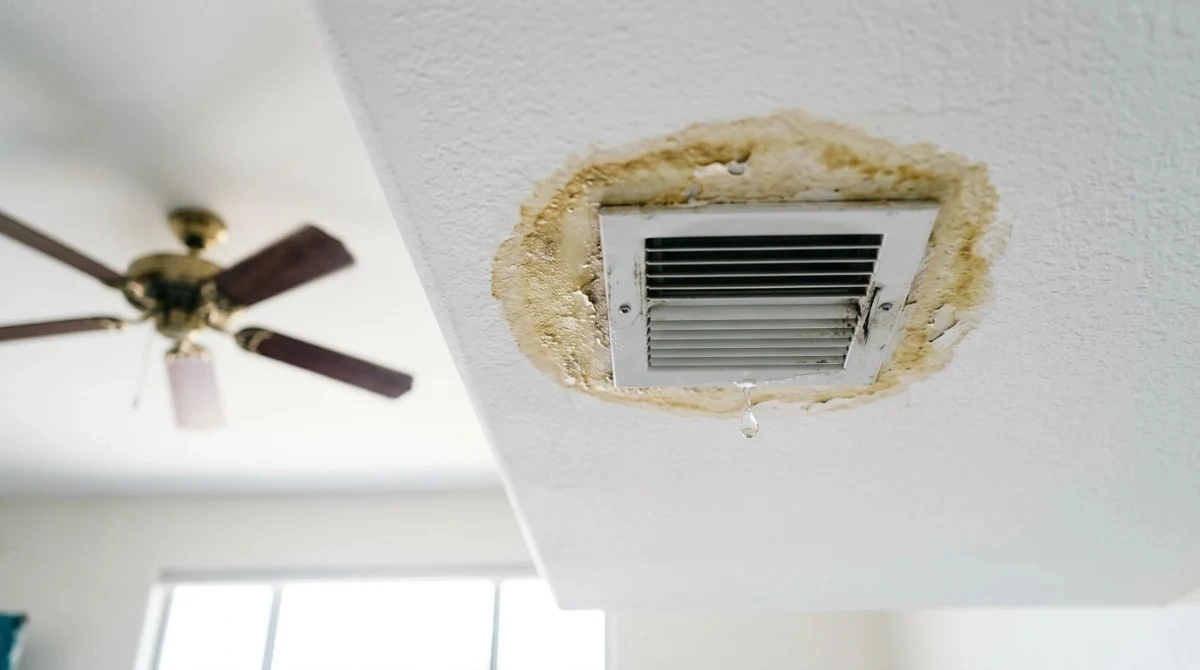
- A stain on the ceiling. By this point the water has already been running into insulation and drywall for days.
The float switch, and why yours might not be there
A float switch sits in the drain pan. When water rises to a set level it breaks the low-voltage circuit to the thermostat and shuts the air conditioning off, before the pan overflows.
So if your AC stops working in August for no apparent reason and the house is otherwise fine, do not assume the worst about the compressor. Open the air handler cupboard and look at the pan first — a system that switched itself off is often a system that just prevented a ceiling collapse.
Attic-mounted units in Arizona are generally required to have a secondary pan and a float switch as a second line of defence. Older installations sometimes do not, and retrofitted ones sometimes have the switch fitted but not wired. If yours is in the attic, that is worth checking before next summer, not during it.
Why an attic unit is the expensive version
A garage or closet unit that overflows makes a mess on a floor. An attic unit that overflows sends water down through the ceiling.
What it passes through on the way is the problem: blown insulation, which holds water and then holds it against the drywall; the ceiling board itself, which is the last thing to show a stain; and often wiring and light fittings. And it does all of this in a space nobody enters between June and October.
That delay is why condensate leaks are so often found late, and why they turn into mold jobs. Growth can begin within 24 to 48 hours where moisture remains — and an attic in a Phoenix summer is warm, dark and undisturbed.
What you can do yourself
- Find the outdoor end of the secondary line and check whether it drips while the system runs. Learn where it is now, while nothing is wrong.
- Look in the drain pan once a month through cooling season. Dry is correct.
- Clear the line at the access tee — the capped T-fitting near the air handler. A wet/dry vacuum on the outdoor end will pull most early clogs straight out.
- Do not pour bleach down it. It corrodes the pan and the fittings over time, and it does not deal with the film on the pipe wall. Warm water with a little vinegar is the usual recommendation.
- Ask for the line to be cleared at your annual service. It is a five-minute job that is routinely skipped.
When it is past that
If there is already a stain on the ceiling, the drywall is soft, or you can see wet insulation, the clog is the smaller half of the problem. What matters then is how far the water travelled and whether the cavity is dry — and neither of those can be judged by looking at the paint.
The order matters too: an HVAC technician clears the line, but that does not dry the ceiling. Those are two different trades and both are needed.
The one thing worth doing this week
Go and look at the drain pan. It takes two minutes, it is dry in a healthy system, and it is the earliest warning you will get — several days before anything appears on a ceiling.
If there is already water coming through
One call connects you with a local restoration contractor covering Phoenix and the Valley. See water damage repair for what drying involves, or mold remediation if the leak has been running longer than a couple of days.
Call (602) 962-2002 — emergency calls answered 24/7.